
How to Choose Curriculum for Florida PEP Students: 5 Steps
You have a Florida Personalized Education Program (PEP) scholarship and need to choose curriculum. This page is about choosing, not purchasing. PEP is a scholarship account administered by a Scholarship Funding Organization (SFO) — Step Up For Students or AAA Scholarship Foundation. It is separate from district home education.
Confirm current requirements with the Florida Department of Education and your SFO. Tools for Education does not name, rank, or endorse any curriculum, publisher, or store, and does not list award amounts.
Last verified:
Video explainer
At a glance
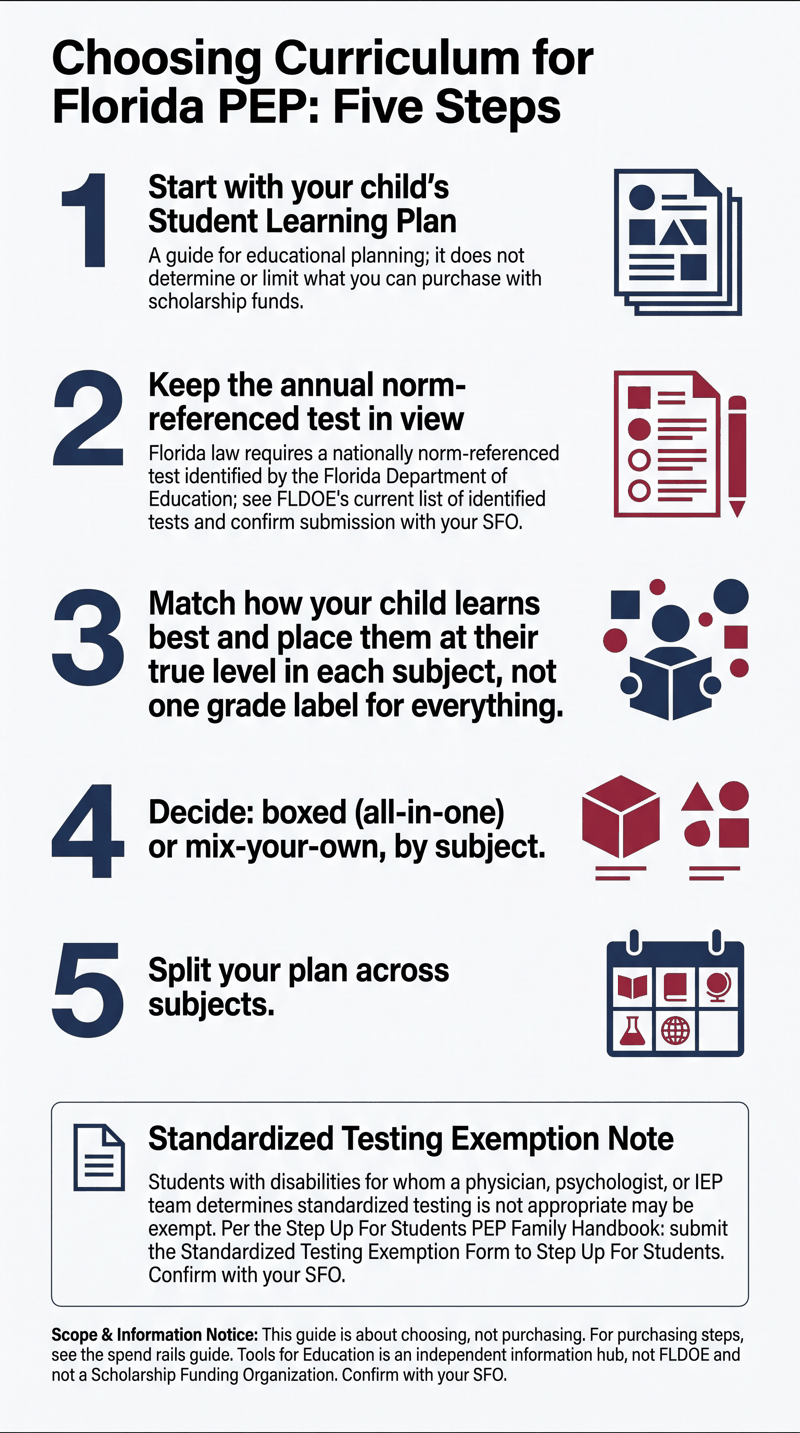
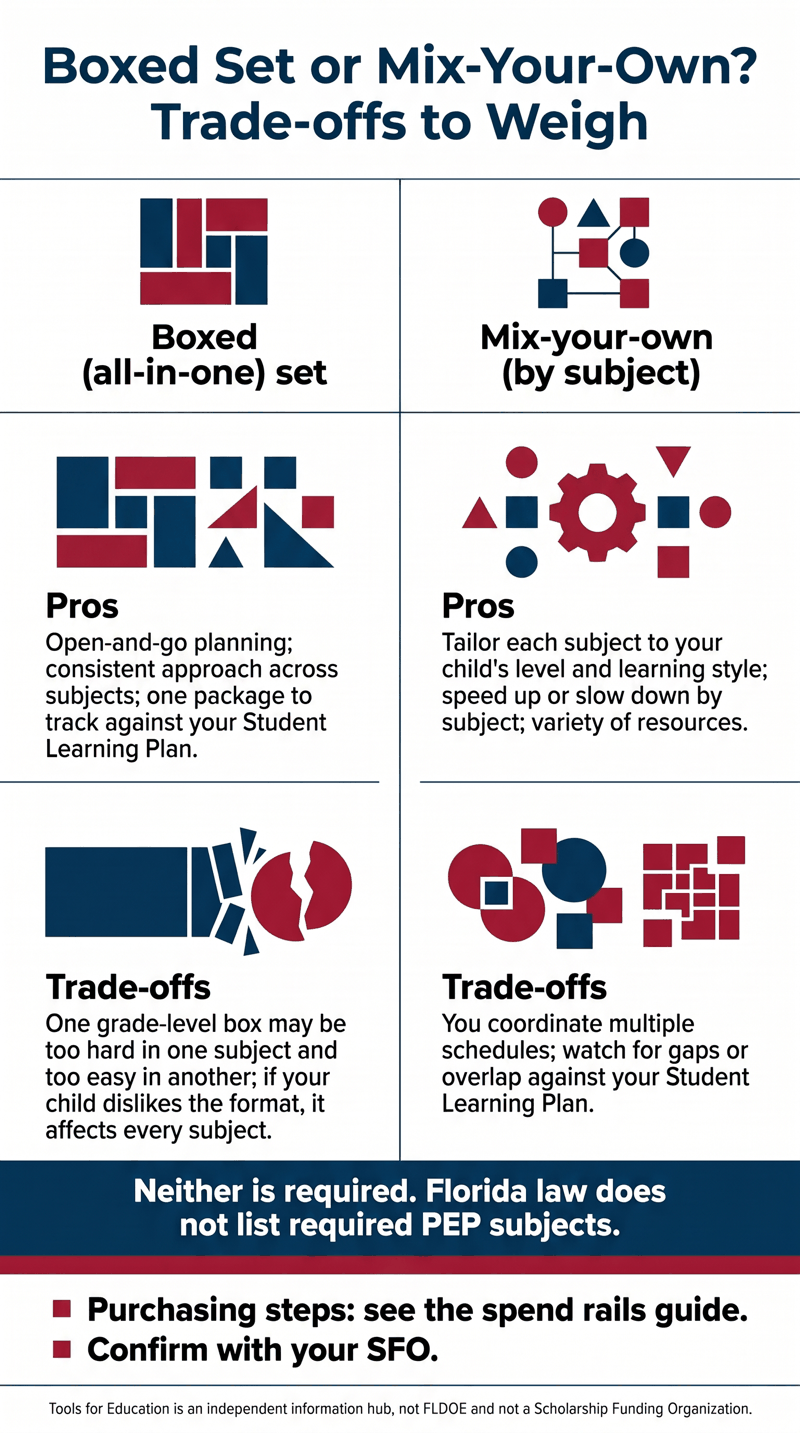
Two visuals for the same written guide: five steps for choosing, and the trade-offs between a boxed set and a mix-your-own plan.
1. Start with the Student Learning Plan
Choosing starts with the plan you already have to write, not with a catalog. A parent whose student will not be enrolled full time in a public or private school signs an agreement with the SFO. That agreement includes submitting a student learning plan and revising it at least annually before program renewal (s. 1002.395(7)(b)2.c., F.S.).
Florida law defines a student learning plan as “a customized learning plan developed by a parent, at least annually, to guide instruction for his or her student and to identify the goods and services needed to address the academic needs of his or her student” (s. 1002.395(2)(n), F.S.).
The Step Up For Students PEP Family Handbook (Student Learning Plans, last modified September 16, 2026) describes the plan as one parents or guardians develop and update annually to guide instruction and address the student’s academic needs, including any remaining instructional time. The handbook says the SLP acts as a guide for educational planning, and it does not determine or limit what the parent or guardian can purchase with scholarship funds. It also says the SLP must be submitted in order to receive scholarship funding, and that Step Up has a template in its family portal. Confirm the current fields and how you submit the plan with your SFO.
The same handbook line is the source for the infographic’s Student Learning Plan sentence. It is handbook wording, not a sentence from the statute.
Florida law does not prescribe a PEP subject list or a public-school pacing guide. An SFO may require an online platform for direct purchases of products so long as that use does not limit a parent’s choice of curriculum or academic programs (s. 1002.395(6)(u), F.S.). The limit on further regulation is s. 1002.395(7)(c), F.S.: “An eligible nonprofit scholarship-funding organization may not further regulate, exercise control over, or require documentation beyond the requirements of this subsection unless the regulation, control, or documentation is necessary for participation in the program.”
The SFO must maintain the plan and allow parents to submit, access, and revise it continuously (s. 1002.395(6)(e)5., F.S.). Together with the annual revision before renewal, that means you can update the plan in the SFO portal. Confirm current portal practice with your SFO.
Before you look at materials, use the plan as a filter:
- What are this year’s academic priorities?
- Where does your child need more support, and where are they ready to move ahead?
- Which electives or specialized subjects are already written into the plan?
Tools for Education is an independent information hub. We are not the Florida Department of Education and not a Scholarship Funding Organization. Confirm eligibility, applications, and payments with FLDOE and your SFO.
2. Keep the annual test in view
Before program renewal, the parent must require the student to take a nationally norm-referenced test identified by the Department of Education, or a statewide assessment under s. 1008.22, and provide the results to the SFO (s. 1002.395(7)(b)2.d., F.S.). Both options are in the statute. The infographic above names the norm-referenced option; this page names both.
See the Florida Department of Education’s current list of identified tests, and confirm how you submit results with your SFO. This page does not reprint that list.
The Step Up For Students PEP Family Handbook (Annual Assessment Requirements, last modified September 16, 2026) restates that duty for FTC-PEP students: take a nationally norm-referenced test identified by the Florida Department of Education or the statewide assessment described in s. 1008.22, and submit the results to Step Up For Students before receiving FTC-PEP scholarship funding in a later year or switching to a different scholarship program. Confirm the current submission steps in your SFO portal.
Students who may be exempt
Section 1002.395(7)(b)2.d., F.S., does not itself state an exemption. The exemption below is from the Step Up For Students PEP Family Handbook, not from the statute.
The handbook says students with disabilities for whom a physician, psychologist, or IEP team determines that standardized testing is not appropriate are exempt from this requirement, and that these students must submit the Standardized Testing Exemption Form to Step Up For Students. The Step Up PEP Fund page says such students may qualify for an exemption. The exemption depends on that determination and on submitting the form, so this guide says they may be exempt or may qualify. Confirm with your SFO.
A district portfolio review is a different rule
Families coming from district home education sometimes expect the same annual options. They are not the same. A teacher portfolio evaluation under s. 1002.41(1)(f)1., F.S. — a teacher the parent selects who holds a valid regular Florida certificate to teach academic subjects at the elementary or secondary level — does not satisfy the PEP testing duty. PEP requires the norm-referenced test identified by the Department of Education, or the statewide assessment under s. 1008.22, with results to the SFO. How district home education and PEP differ is covered in District Home Education vs. PEP.
When you choose materials, keep foundational reading, language arts, and mathematics in view. Norm-referenced tests measure skills such as reading comprehension, vocabulary, language mechanics, mathematical computation, and problem-solving against a national group. Review a program’s scope and sequence so those skills show up in an orderly progression, whatever instructional approach you use. The annual result is a check on whether the materials left a gap you may want to adjust later. It is not a script this hub tells you to teach line by line.
3. Match materials to how your child learns
Place your child at their true level in each subject. One grade label for every subject can be too hard in one area and too easy in another. A child may read ahead of the math they need, or the reverse. Do not assume grade labels from different materials mean the same thing.
Generic approaches, not product recommendations, include:
- Literature and visual reading — narrative books, discussion, and reading in place of a single textbook voice.
- Hands-on materials — manipulatives, models, and activities a child can do, especially when a concept needs to be concrete.
- Listening and discussion — read-alouds, spoken explanation, and conversation.
- Mastery — stay with one concept until it is solid before moving on.
- Spiral review — introduce a concept, leave it, and come back with more depth.
- Self-paced digital lessons — on-screen instruction with immediate feedback.
Tools for Education does not name publishers and does not claim that placement tools are free or widely offered. If you want a placement check for a specific set of materials, confirm that with the provider.
4. Boxed set or mix-your-own
Either approach can work. Section 1002.395, F.S., does not list required PEP subjects or a required curriculum format. Florida law does require the parent-written Student Learning Plan described above. Do not treat a boxed package’s table of contents as a statutory subject list.
Boxed (all-in-one)
A boxed set is one package for the year: student books, teacher plans, and tests across subjects, with a schedule already built. Planning is open-and-go. The tone and layout stay consistent. One package can cover the areas you document in the Student Learning Plan.
The trade-off is fit. If your child is ahead in one subject and behind in another, one grade-level box may be too hard in one subject and too easy in another. If your child dislikes the format, that friction shows up in every subject.
Mix-your-own (by subject)
A mix-your-own plan lets you choose materials subject by subject: the level and approach for math can differ from reading, science, or history. You can speed up one subject and slow down another, and you can mix books, hands-on materials, and digital lessons.
The trade-off is coordination. You keep the schedules aligned, and you watch for gaps or overlap against the Student Learning Plan.
A parent may combine a structured program for language arts and mathematics with separately chosen literature, science, and electives. That is a packaging option. It is not a statutory requirement, and this guide does not claim it is what most families do.
5. Pace choices across the year
Spread the plan across subjects over the school year. Put core instructional materials first — mathematics and language arts — then science and social studies, then electives. Leave room later in the year for consumable materials (workbooks, activity packs, lab supplies that are used up) and for assessment fees. Durable guides, such as a teacher manual or a reference book, can be kept and reused. Consumables cannot.
For choosing instructional materials, the authorized uses in s. 1002.395(6)(d)4., F.S., include instructional materials, including digital materials and Internet resources (paragraph 4.b.); curriculum as defined in s. 1002.394(2) (paragraph 4.c.); and fees for nationally standardized, norm-referenced achievement tests and other assessments listed in that paragraph (paragraph 4.e.). A parent affirms that program funds are used only for authorized purposes serving the student’s educational needs, as described in paragraph (6)(d) (s. 1002.395(7)(b)2.a., F.S.).
Tools for Education does not list scholarship award amounts, percentages, or funding ranges. The Florida Legislature sets scholarship amounts annually. Confirm the balance that applies to your student in your SFO account.
PEP and district home education stay separate
PEP is a scholarship account administered by an SFO under s. 1002.395, F.S. District home education is a different program under s. 1002.41, F.S. A student is not eligible for this scholarship while participating in a home education program as defined in s. 1002.01(1) (s. 1002.395(4)(e), F.S.). While a student is in PEP, the annual Student Learning Plan and the test results go to the SFO. They are not the district home-education evaluation.
What is different, and why it matters, is in District Home Education vs. PEP. If you are moving from district home education to PEP, confirm the required notice and timing with your district and your SFO.
Where purchasing steps live
This page stops at choosing. How to pay for materials is only in the scholarship spend rails guide.
FAQ
Do we have to buy a boxed curriculum?
No. Either a boxed set or a mix-your-own plan can work. Section 1002.395, F.S., does not list required PEP subjects or a required curriculum format. You still submit a parent-written Student Learning Plan.
Which test can we use?
A nationally norm-referenced test identified by the Florida Department of Education, or a statewide assessment under s. 1008.22, F.S. See FLDOE’s current list of identified tests and confirm submission with your SFO.
Does a teacher portfolio review meet the PEP test?
No. A teacher portfolio evaluation under s. 1002.41(1)(f)1., F.S., is a district home-education option. It does not satisfy s. 1002.395(7)(b)2.d.
Who may be exempt from standardized testing?
The Step Up For Students PEP Family Handbook, not the statute, describes an exemption for students with disabilities when a physician, psychologist, or IEP team determines that standardized testing is not appropriate, using the Standardized Testing Exemption Form submitted to Step Up For Students. The handbook says they are exempt in that case. The Step Up PEP Fund page says they may qualify for an exemption. Confirm with your SFO whether your student may be exempt or may qualify.
Where do I read how to pay for materials?
On the scholarship spend rails guide. This page does not cover payment steps.
How much is the scholarship?
We do not list scholarship award amounts. The Legislature sets amounts annually. Confirm yours in your SFO account.
Where to verify
Student learning plan rules, testing rules, and handbook wording are updated by the Legislature and by SFOs. Confirm current details with these sources, and with your SFO, before you rely on them: