
Florida Homeschool Annual Evaluations: Your 5 Options Explained
If your student is registered in a Florida district Home Education program, you choose one of five statutory methods for the annual educational evaluation. This guide explains what each option involves, what goes to the district, and what stays at home.
File the evaluation annually; confirm with your district. This guide is independent information, not legal advice or a district instruction.
Last verified:
Starting district Home Education? Read the Florida Home Education Notice of Intent guide for the district filing step.
Video explainer
At a glance
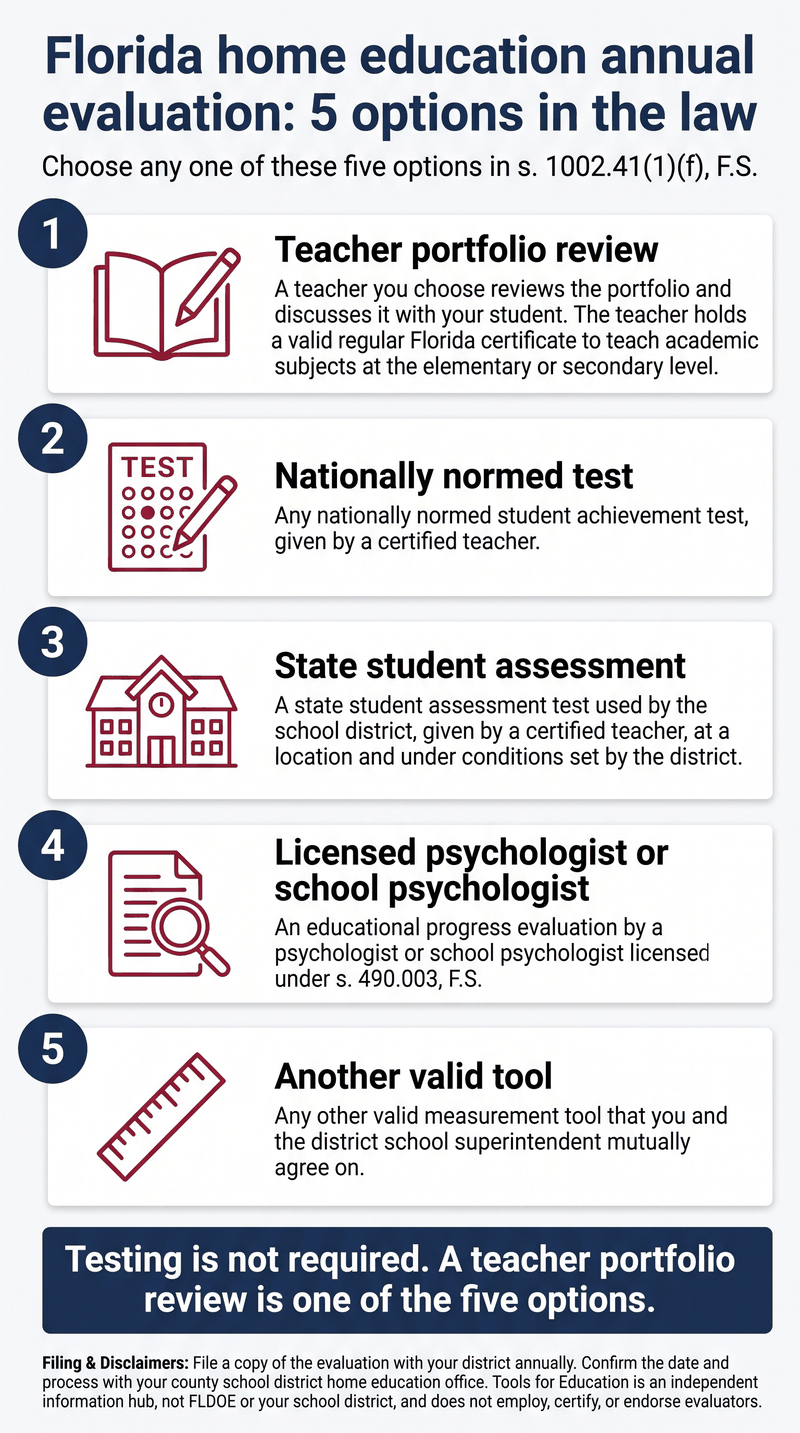
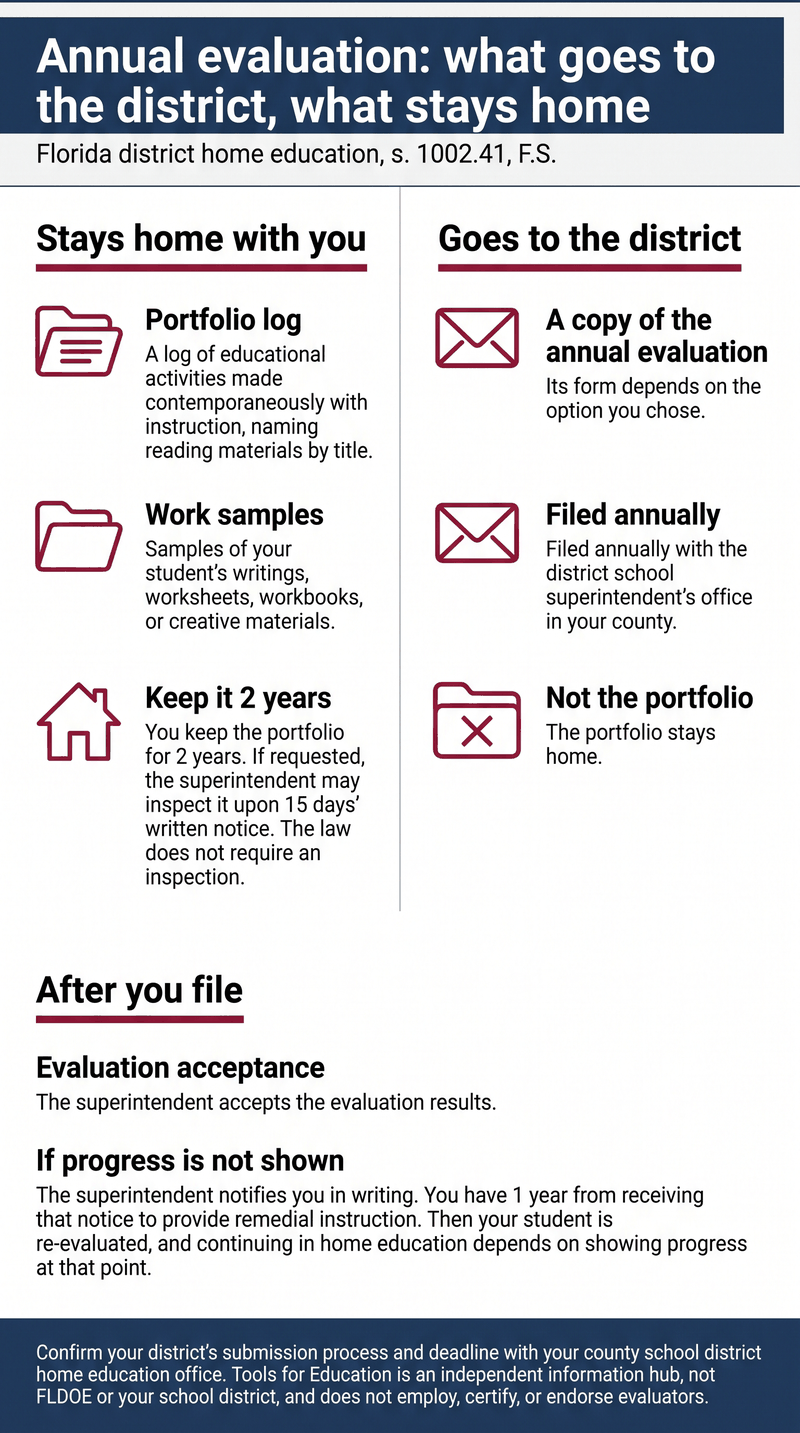
The accepted T07 visuals summarize the five options and the difference between your district submission and your home records.
Understanding Florida’s annual evaluation requirement
What the statute asks for
Section 1002.41(1)(f), Florida Statutes, requires a parent in a district Home Education program to provide an annual educational evaluation documenting the student’s educational progress at a level commensurate with the student’s ability. The parent selects the evaluation method and files a copy with the district school superintendent’s office in the county where the student lives.
The law requires you to file a copy of the evaluation annually. Confirm the date and process with your district. County offices can publish their current submission process, contact details, and date instructions.
Testing is not required
Standardized testing is one option, not the only option. A teacher portfolio review, a state student assessment, an educational progress evaluation by a licensed psychologist or school psychologist, or another valid tool agreed on with the superintendent are also listed in the statute.
The 5 statutory evaluation options
1. Teacher portfolio review
A teacher selected by the parent evaluates the student’s educational progress upon review of the portfolio and discussion with the student. The teacher must hold a valid regular Florida certificate to teach academic subjects at the elementary or secondary level.
2. Nationally normed student achievement test
The student takes any nationally normed student achievement test administered by a certified teacher. Ask the administering teacher what report or evaluation statement will be provided for your district submission.
3. State student assessment
The student takes a state student assessment test used by the school district, administered by a certified teacher at a location and under conditions set by the district. Ask your district home education office about available dates, locations, and sign-up steps.
4. Educational progress evaluation by a licensed psychologist or school psychologist
The student is evaluated by an individual holding a valid, active license under section 490.003(7) or (8), Florida Statutes. This is an educational progress evaluation; it is not a requirement to pursue therapy, diagnosis, or clinical services.
5. Another valid measurement tool agreed on with the superintendent
The student may be evaluated with another valid measurement tool that the district school superintendent and parent mutually agree on. Confirm the tool and the district’s submission expectations with the superintendent’s office before relying on this option.
What goes to the district, and what stays home
Submit a copy of the evaluation
After your selected evaluation is complete, file a copy of the evaluation with the district school superintendent’s office. The document depends on the option you selected: it may be a teacher’s written statement, a test score summary, a state assessment result, a licensed professional’s written evaluation, or the result of the mutually agreed tool.
Confirm whether your district accepts email, mail, a portal, or another submission method. Keep your delivery confirmation and a copy of what you filed.
Keep the portfolio at home
Your portfolio includes a contemporaneous activity log naming reading materials by title and samples of the student’s work. Keep it for at least two years. The superintendent may inspect it upon 15 days’ written notice if an inspection is requested; the law does not require an inspection.
How PEP is different
The Personalized Education Program (PEP) is a separate path from district Home Education. PEP is a scholarship account administered by the SFO (Scholarship Funding Organization), rather than a district Home Education registration.
PEP families follow their SFO’s current assessment and renewal instructions. The assessment result is submitted to the SFO through its portal, not as the district Home Education annual evaluation described on this page. Confirm the current requirements in your SFO portal, whether you use Step Up’s EMA or AAA’s SMP.
Tools for Education is an independent information hub. We are not FLDOE, a school district, or an SFO, and we do not employ, certify, or endorse evaluators. Confirm live eligibility, deadlines, evaluator credentials, and submission rules with the official source.
What happens after you file
The superintendent accepts the results of the annual educational evaluation. If the evaluation does not show educational progress commensurate with the student’s ability, the superintendent notifies the parent in writing. The parent then has one year from receiving that notice to provide remedial instruction. At the end of the 1-year probationary period, the student is re-evaluated using one of the five options specified in s. 1002.41(1)(f). Continuation in a home education program is contingent upon the student demonstrating educational progress commensurate with their ability at the end of the probationary period.
Keep a copy of the evaluation, your submission confirmation, and your home portfolio with your family records.
Where to verify
Rules and district procedures can change. Verify the current requirement and your county’s submission process with official sources: