

FES-UA October 31 Reimbursement Deadline & EMA Appeals, Explained
If your family uses Florida’s Family Empowerment Scholarship for Students with Unique Abilities (FES-UA), two Education Market Assistant (EMA) portal rules matter right now: the October 31 deadline to submit 2025–26 reimbursement receipts, and the single in-portal appeal if a reimbursement request is denied. Here is what each actually covers — and what it does not.
Confirm current eligibility, documentation standards, and purchase rules in your authenticated EMA or AAA SMP account. This hub does not approve reimbursement requests or disburse funds.
Video explainer
At a glance
Two visuals for the same two rules in the written guide: what October 31 covers, and the one EMA appeal path.
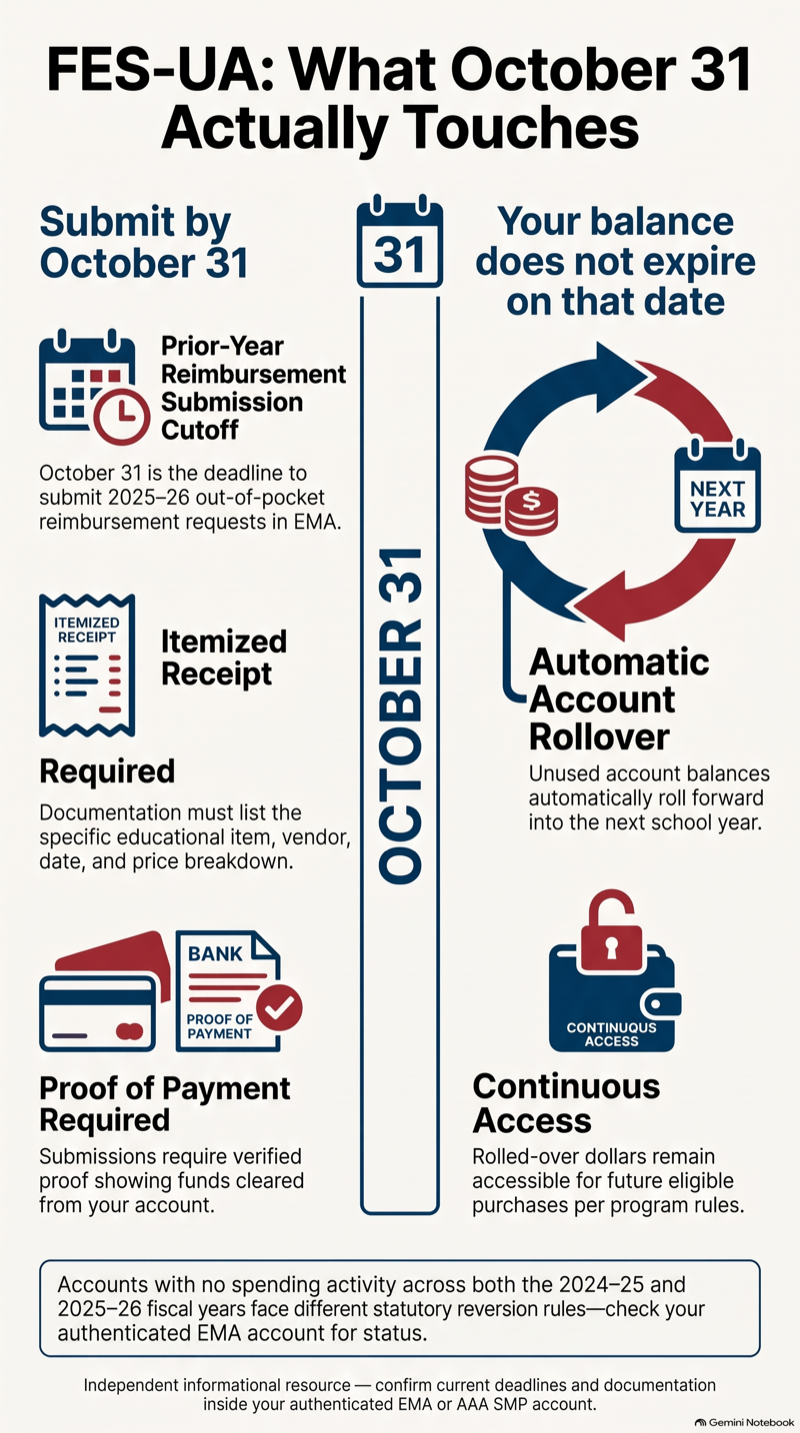
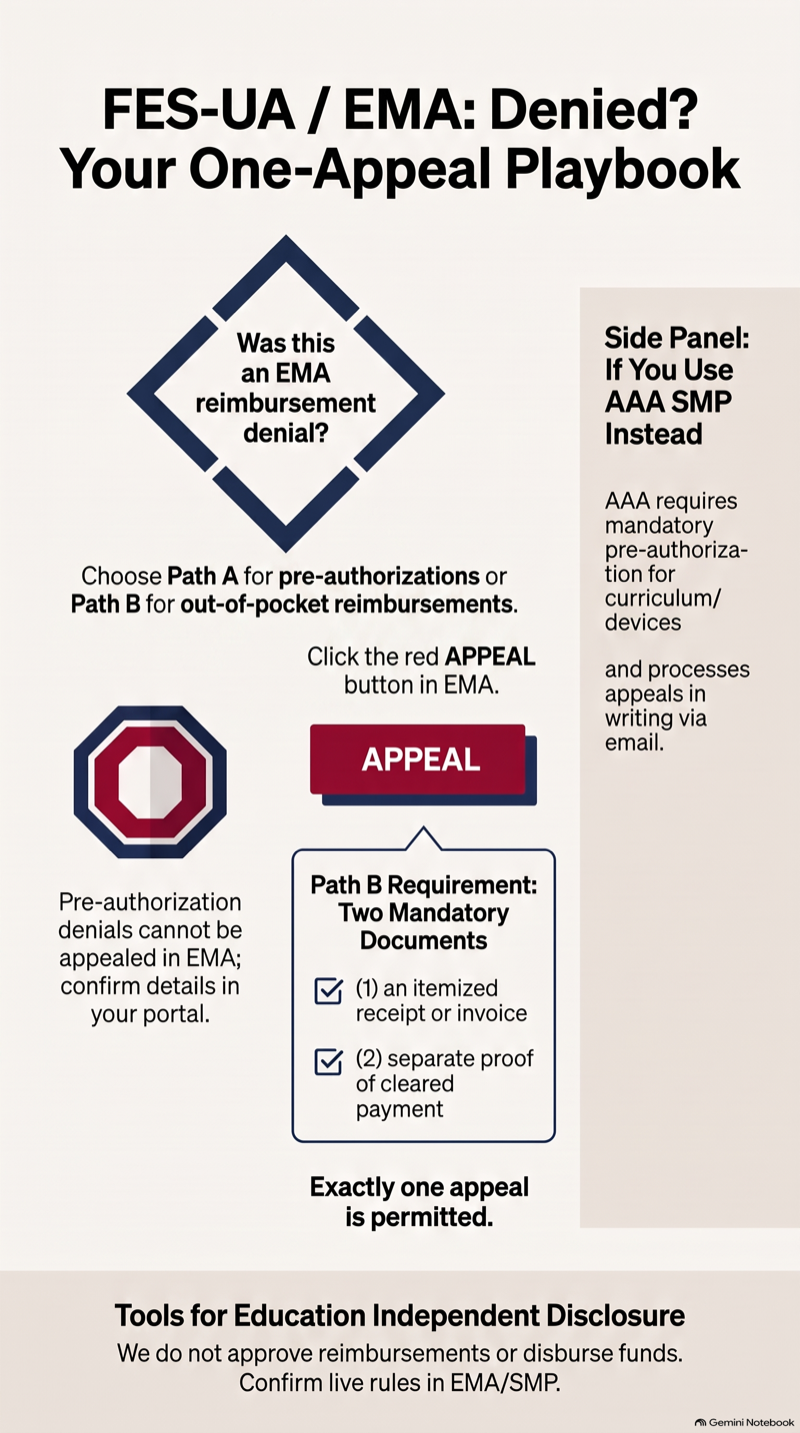
What the October 31 deadline covers
In Step Up For Students’ Education Market Assistant (EMA), reimbursement requests follow an annual school-year calendar running July 1 through June 30. Under standard guidelines, reimbursement requests for a given school year must be submitted by the following July 31.
For the 2025–26 school year specifically (purchases made between July 1, 2025 and June 30, 2026), Step Up For Students authorized an extended submission cutoff of October 31, 2026 at 11:59 PM Eastern Time. That extension is specific to this one cycle — the standard July 31 deadline applies to other school years.
What closes at that moment is narrow and specific: the ability to submit out-of-pocket reimbursement claims for purchases made during the 2025–26 school year. Receipts from that prior cycle become ineligible for reimbursement once the window closes.
What does not expire: your account balance
A common and understandable worry is that unspent FES-UA funds “expire” or get forfeited on October 31. That is a misconception the official sources are explicit about.
Under Florida law (s. 1002.394(5)(b)2., F.S.), scholarship accounts allow continuing rollover: reimbursements for program expenditures may continue until the account balance is expended or the account is closed. Step Up’s own FES-UA Family Handbook states that unspent scholarship funds may be rolled over from one school year to the next, and remain accessible for eligible expenses in future years as long as the student continues to meet scholarship eligibility requirements.
In plain terms: the October 31 date governs the window to claim reimbursement for 2025–26 receipts. It does not touch the cash balance already sitting in the account. That balance rolls over into the 2026–27 school year, where it can still be spent through MyScholarShop, Find Providers, or a fresh current-year reimbursement request.
Florida statute also sets a maximum account balance that an SFO may hold for an eligible student under s. 1002.394(12)(b)11., F.S. Tools for Education does not list specific scholarship dollar amounts on this hub — confirm any balance-cap or funding question directly with your SFO.
The inactive-account carve-out
The October 31 extension is not universal. Step Up explicitly excludes accounts that meet the statutory definition of inactivity: accounts with no verified spending activity across both the 2024–25 and 2025–26 fiscal years.
Under s. 1002.394(5)(b)3.c., F.S., two consecutive inactive fiscal years can trigger account closure, with remaining balances reverting to the state. If your account has had no spending activity across those two years, contact Step Up directly to confirm whether your account is subject to reversion rather than assuming the Oct 31 extension applies.
The 30-day hold trap
Step Up allows up to 60 days to review a submitted reimbursement request. If an examiner finds missing invoices, unclear dates, or unverified payment proof, the request is flagged “On Hold” and the parent is notified by email.
Parents then have 30 calendar days from that notice to upload the requested documentation. If no cure is submitted within 30 days, the request is automatically denied.
This matters most for anyone submitting close to October 31: if that late submission gets flagged for missing documentation, the family’s only path forward is the 30-day cure window and, if it still ends in denial, the single appeal described below — with no opportunity to file a brand-new request for that prior year.
EMA’s single-appeal rule for denials
If Step Up denies a reimbursement request in EMA, the parent is permitted exactly one appeal, and only through the in-portal red APPEAL button. Step Up’s handbook is explicit that appeals sent by email, phone, or any other customer-service channel are not reviewed, and that after the appeal decision is made, additional appeals for the same item will not be reviewed.
- Log into the EMA dashboard via the official Step Up login gateway.
- Open the Reimbursements tab and locate the specific denied request.
- Review the denial reason in the request notes and in the email sent to your registered EMA address.
- Scroll to the bottom of the transaction screen to find the red APPEAL button.
- Reopen the upload interface, update the justification, and attach the missing documentation.
- Submit the appeal. The decision is final — there is no second appeal for the same item.
Pre-authorization denials cannot be appealed at all. If a parent submits an advance pre-authorization request for an item not explicitly listed in the Purchasing Guide and it is denied, that denial is not appealable. Pre-authorizations exist to protect parents from out-of-pocket loss; a negative determination means the item was found non-compliant with state purchasing guidelines before any money was spent.
The two required documents
A common source of reimbursement denial is mixing up evidence of purchase with proof of payment. Every EMA reimbursement submission needs both.
The itemized receipt or invoice (“the what”)
This document shows the student’s full legal name (or a clear account tie), the provider or merchant name, a complete transaction date, and an itemized breakdown of each item or service with its own cost — not a generic line like “educational supplies” or “tutoring package” with no dates or unit costs. Handwritten receipts, shopping-cart screenshots, and private cash sales (garage sales, classified listings, unaffiliated individuals) are not accepted.
Proof of cleared payment (“the how”)
This is separate from the receipt and must show the payment actually cleared: a cancelled check (front and back), a card receipt showing the merchant, date, amount, and masked card number, a bank or card statement line matching the purchase, a mobile-payment confirmation (PayPal, Venmo, Zelle, Cash App showing date, recipient, and amount), or a “Paid in Full” invoice with payment method, date, and zero balance shown.
A document only marked “PAID” or showing “$0.00 Balance Due” without a payment method, date, or transaction context is not sufficient on its own and can trigger a hold or denial.
How AAA Scholarship Foundation differs
Families with AAA Scholarship Foundation operate under a different portal and different rules — the EMA-specific details above do not carry over automatically.
| Dimension | Step Up For Students (EMA) | AAA Scholarship Foundation (SMP) |
|---|---|---|
| Portal | Education Market Assistant (EMA) | Scholarship Management Platform (SMP) |
| 2025–26 reimbursement cutoff | Extended to October 31, 2026 (standard: July 31) | Governed by AAA’s own handbook cycle; no EMA-style Oct 31 extension |
| Pre-authorization | Optional — used for items not listed in the Purchasing Guide | Mandatory for instructional materials, digital devices, and curriculum before purchase |
| Appeal mechanism | In-portal only: red APPEAL button; exactly one appeal | Written appeal submitted to AAA; one-time appeal within AAA’s stated window |
| Pre-authorization appeals | Not permitted | Permitted, submitted in writing |
FAQ
Is October 31 a real reimbursement deadline?
Yes, for 2025–26 prior-year receipts specifically. Step Up extended the standard July 31 cutoff to October 31, 2026 at 11:59 PM Eastern Time for that one school year’s out-of-pocket reimbursement claims.
Do unspent FES-UA funds expire or get forfeited on October 31?
No. That is a misconception. Under s. 1002.394(5)(b)2., F.S. and Step Up’s own handbook, unspent account balances roll over into the next school year. What closes on October 31 is the window to submit 2025–26 reimbursement receipts — not the money already in the account.
Can every account use the October 31 extension?
No. Accounts with no verified spending activity across both the 2024–25 and 2025–26 fiscal years are excluded from the extension and may be subject to statutory reversion under s. 1002.394(5)(b)3.c., F.S. Contact Step Up to confirm your account’s status.
How many times can I appeal a denied reimbursement?
Exactly once, and only through the in-portal red APPEAL button in EMA. Step Up does not review appeals sent by email, phone, or any other channel, and the appeal decision is final.
What documents does a reimbursement request need?
Two separate documents: an itemized receipt or invoice showing what was purchased, and separate proof that the payment actually cleared (a cancelled check, card receipt, statement line, mobile-payment confirmation, or a Paid in Full invoice). A generic “PAID” stamp alone is not enough.
Does AAA Scholarship Foundation follow the same rules?
No. AAA manages its program through the Scholarship Management Platform (SMP), requires mandatory pre-authorization for curriculum and materials, and handles appeals in writing rather than through an in-portal button.
Where to verify
Purchasing guidelines, documentation standards, and deadlines are updated periodically by SFOs. Confirm current rules directly with official sources before making significant out-of-pocket purchases:
- Florida Statutes — Section 1002.394 (Family Empowerment Scholarship Program)
- Step Up For Students — FES-UA Family Handbook
- Step Up — Purchasing Guides Summary of Changes
- Step Up — Purchasing Guides Central Hub
- Florida Center for Students with Unique Abilities — FES-UA Purchasing Guidelines
- Step Up — Logins & EMA Gateway
- Step Up — Program Handbooks Index
- AAA Scholarship Foundation — SMP FAQ
- AAA Scholarship Foundation — Florida Disability-Based Scholarships (FES-UA)