

Superintendent certificates of exemption from school attendance
Someone said the superintendent can excuse a child from attending school this year. Section 1003.21(3), F.S., says the district school superintendent may authorize certificates of exemption from school attendance requirements in certain situations. This page is about that sentence: what it authorizes, how long a certificate lasts, and how it differs from a home education program. It is not legal advice.
Confirm any local criteria with your district school superintendent, and current rules with the Florida Department of Education (FLDOE) or the statute. Tools for Education does not issue, review, or decide on certificates of exemption.
Video explainer
At a glance
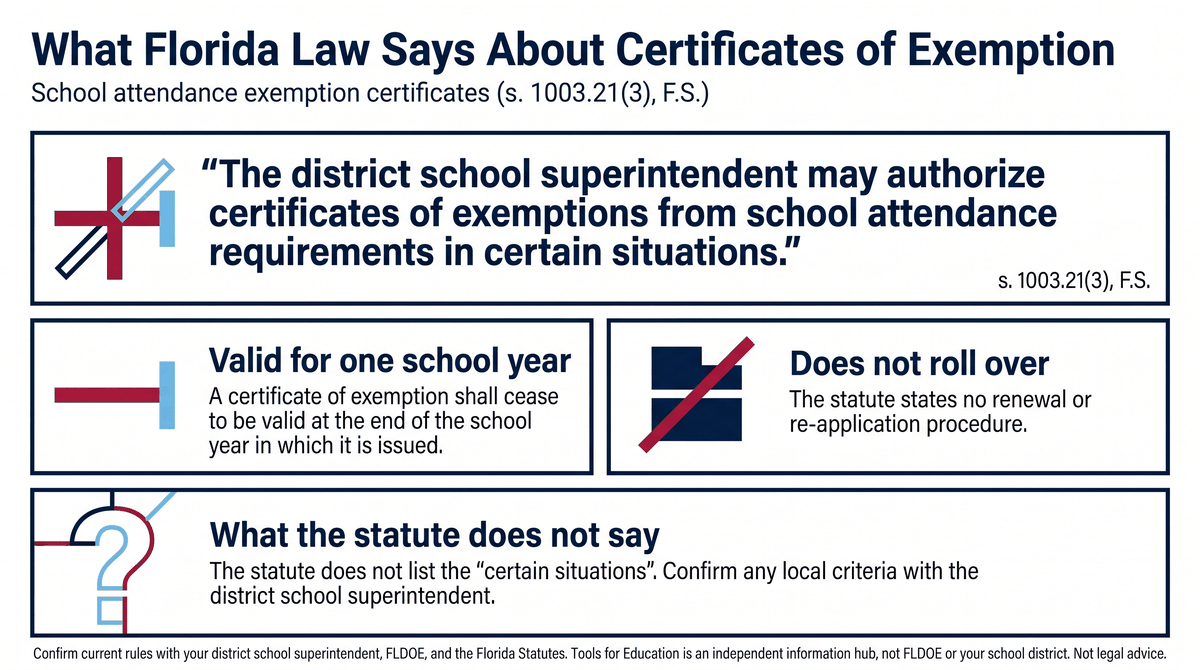
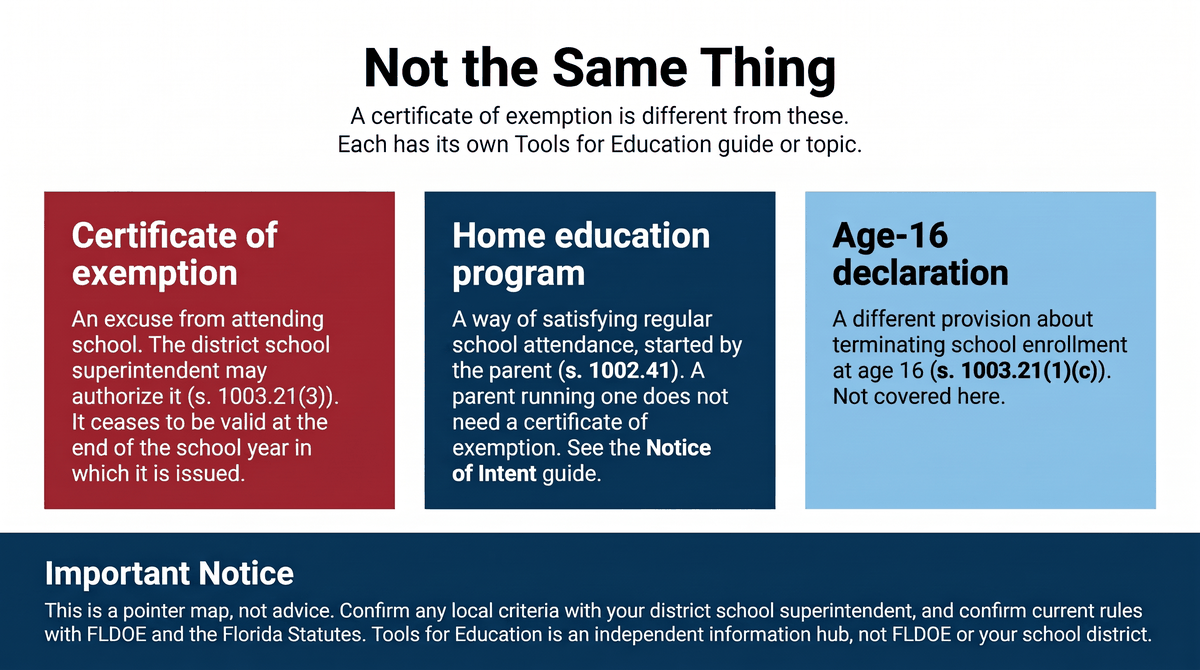
Two visuals for the same written guide: what the statute says about the certificate, and how it differs from home education and the age-16 declaration.
What the statute says
Section 1003.21(3), F.S., states: “The district school superintendent may authorize certificates of exemptions from school attendance requirements in certain situations.”
The same subsection continues: “Students within the compulsory attendance age limits who hold valid certificates of exemption that have been issued by the superintendent shall be exempt from attending school.”
The legal power to authorize the certificate rests with the district school superintendent. This page does not invent the “certain situations.” The 2026 sentence names no list of qualifying facts. Confirm any local criteria with that office.
Tools for Education is an independent information hub. We are not FLDOE and not a school district. We do not issue, review, or decide on certificates of exemption. This page is not legal advice. Confirm any local criteria with your district school superintendent, and current rules with FLDOE or the statute.
How long it lasts
Section 1003.21(3), F.S., states: “A certificate of exemption shall cease to be valid at the end of the school year in which it is issued.”
It does not roll over automatically. The statute states no renewal or re-application procedure. It does not create a multi-year exemption, and it does not permanently release a student from Florida compulsory attendance requirements.
What the statute does not say
Section 1003.21(3), F.S., does not set these items:
- A statewide list of qualifying situations, examples, or categories. The text says only “in certain situations.”
- A form, fee, or application process.
- Automatic renewal, rollover, or a later-year procedure.
- Academic credit, diploma standing, or a credential. The subsection addresses compulsory attendance relief only.
Whether any district school superintendent uses local criteria or forms is not a statewide statutory fact. Confirm any local requirements directly with the district school superintendent’s office.
Not the same as home education
A certificate of exemption is an excuse from attending school. A home education program under s. 1002.41, F.S., is a recognized way of satisfying regular school attendance under s. 1003.01(16)(d), F.S.
A home education program is registered with the district school superintendent only for the purpose of complying with the state’s attendance requirements under s. 1003.21(1) (s. 1002.41(1), F.S.). It is not a school district program. A parent who maintains a home education program does not apply for, receive, or operate under a superintendent’s certificate of exemption.
Filing the program lives on the Florida home education Notice of Intent guide. Evaluation methods live on the Florida homeschool annual evaluations guide. The path comparison with the Personalized Education Program (PEP), a scholarship account administered by a Scholarship Funding Organization (SFO), lives on District Home Education vs. PEP. This page does not restate those steps.
| Dimension | Certificate of exemption | District home education | Age-16 declaration |
|---|---|---|---|
| Statute | s. 1003.21(3), F.S. | s. 1002.41, F.S. and s. 1003.01(16)(d), F.S. | s. 1003.21(1)(c), F.S. |
| Legal nature | Exemption from attendance | Method of regular school attendance | Formal termination of enrollment upon reaching age 16 |
| Who authorizes or executes | District school superintendent | Parent establishes by filing Notice of Intent | Student and parent sign a formal declaration |
| Duration | Ceases at the end of the school year issued | Continues until the parent files a written notice of termination | Not subject to compulsory attendance beyond the date the student attains age 16 if the formal declaration is filed |
Not the age-16 declaration
A certificate of exemption under s. 1003.21(3), F.S., is issued by the superintendent. It is an entirely separate provision from the formal declaration of intent to terminate school enrollment filed by a student who attains the age of 16 under s. 1003.21(1)(c), F.S.
This page does not explain how that declaration works. There is no live guide for it on this hub yet.
Related guides on this hub
Notice, path-comparison, switching, evaluation, and private-school details stay on those pages. This page links to them instead of repeating them:
- Florida home education Notice of Intent — the s. 1002.41(1)(a) filing. N01 is the certificate of exemption, not that filing.
- District Home Education vs. PEP — PEP is a scholarship account administered by an SFO and is different from district home education. N01 is not that comparison.
- Switching between Florida home education and PEP — moving between those two paths. N01 does not teach that sequence.
- Florida homeschool annual evaluations — the s. 1002.41(1)(f) evaluation. A certificate of exemption has no evaluation duty in s. 1003.21(3).
- Private “umbrella” schools vs. district home education — private school under s. 1002.42 as a separate attendance path. N01 is not that comparison.
FAQ
Can a Florida superintendent excuse a child from school attendance?
Section 1003.21(3), F.S., says the district school superintendent may authorize certificates of exemption from school attendance requirements in certain situations. Students within the compulsory attendance age limits who hold a valid certificate issued by the superintendent shall be exempt from attending school. Confirm any local criteria with your district school superintendent.
How long does a certificate last?
A certificate of exemption shall cease to be valid at the end of the school year in which it is issued (s. 1003.21(3), F.S.). It does not roll over, and the statute states no renewal or re-application procedure.
What are the “certain situations”?
The statute does not list them. This page does not invent a list. Confirm any local criteria with your district school superintendent.
Is this the same as filing a Notice of Intent?
No. A home education program under s. 1002.41, F.S., is a recognized way of satisfying regular school attendance. A parent who maintains one does not need a certificate of exemption. See the Notice of Intent guide.
Is this the age-16 declaration?
No. The formal declaration of intent to terminate school enrollment in s. 1003.21(1)(c), F.S., is a different provision. This page does not explain how it works.
Does a certificate grant a diploma or academic credit?
No. Section 1003.21(3) addresses compulsory attendance relief only. It grants no academic credits or diploma standing.
Is this a scholarship page?
No. PEP is a scholarship account administered by an SFO and is different from district home education. See District Home Education vs. PEP. This page does not teach scholarships.
Where to verify
Confirm current details with these sources, and with your district school superintendent, before you rely on them. FLDOE web pages were not fetchable when this research was written (HTTP 403) and stay unverified as live web text; the Florida Statutes remain the controlling source.