
Credits, transcripts, and diplomas in a Florida home education program
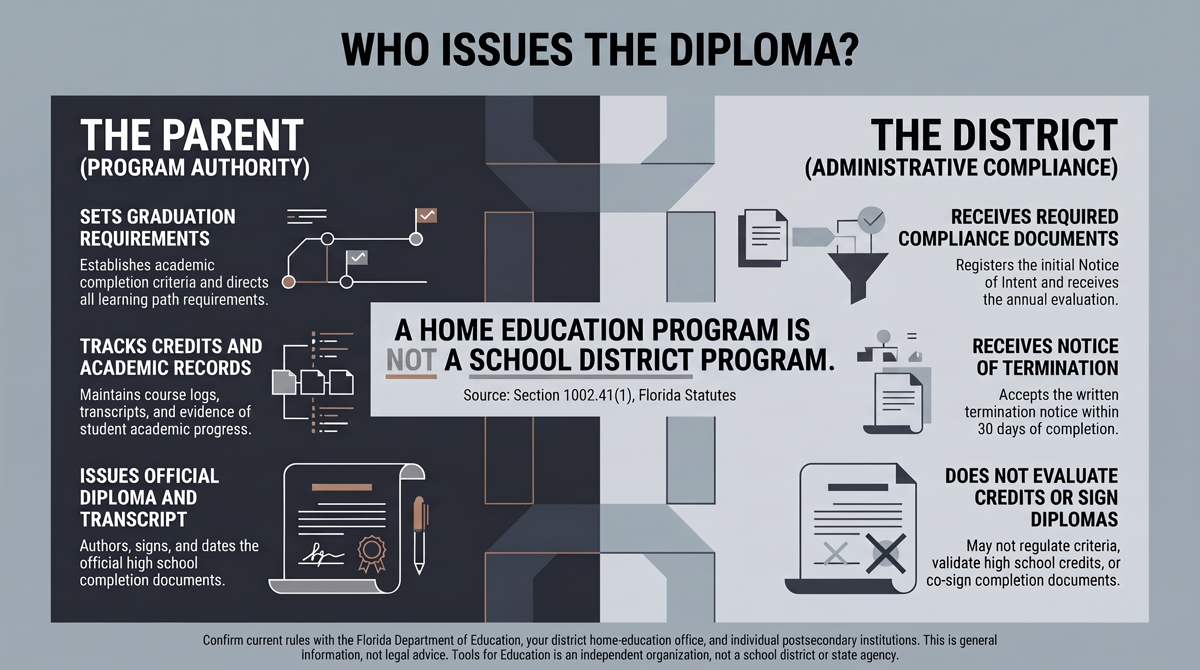
Under section 1002.41(1), F.S., a home education program is not a school district program. The parent sets graduation requirements, tracks credits, and issues the diploma and transcript. The district does not issue the diploma. This page is about that split, what a state university asks to see on a transcript, and how Bright Futures treats a student who completes a home education program. It is not legal advice.
Confirm live rules with the Florida Department of Education (FLDOE), your district home education office, the college’s admissions office, and the Office of Student Financial Assistance. Tools for Education does not issue diplomas or decide admission or Bright Futures eligibility.
Video explainer
At a glance
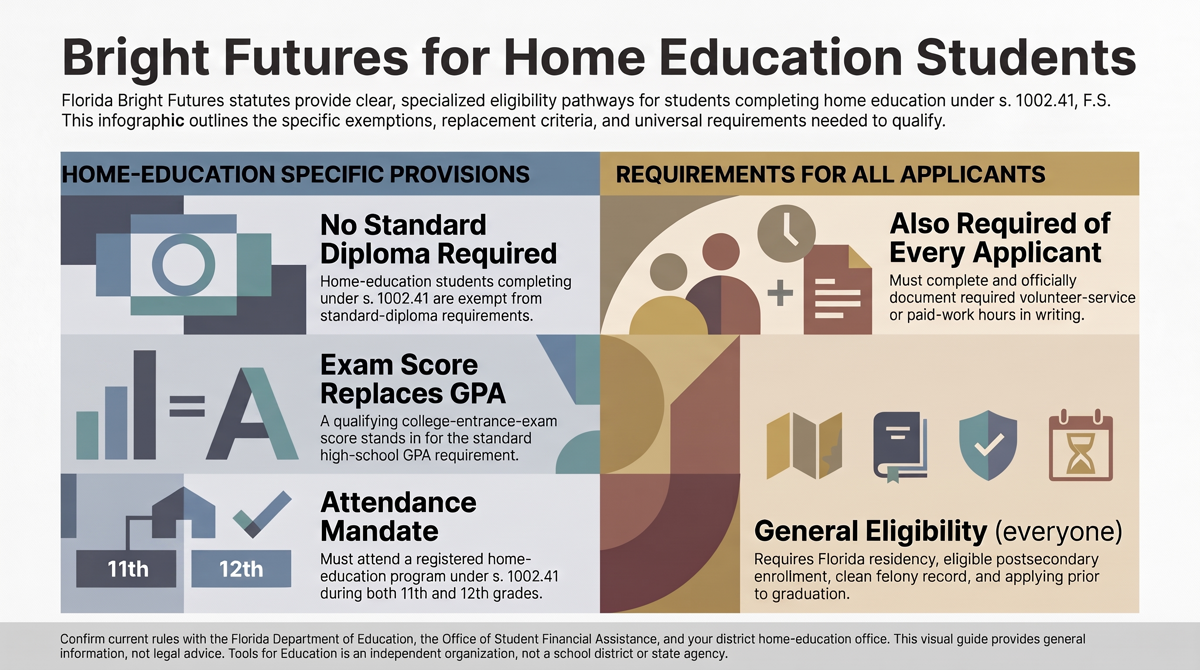
Two visuals for the same written guide: who issues the diploma, and the Bright Futures path for a home education student. Neither visual lists a test score, a test name, or a dollar amount.
Who issues the diploma
Section 1002.41(1), F.S., states: “A home education program is not a school district program and is registered with the district school superintendent only for the purpose of complying with the state’s attendance requirements under s. 1003.21(1).”
The parent directs the program, determines the graduation requirements, and issues the diploma and the transcript. Florida law does not give the district school board or the superintendent a role in evaluating home education credits, setting those graduation requirements, or signing the diploma.
The district’s duties under this section are the filings: registering the Notice of Intent, receiving the annual evaluation, and receiving the written notice of termination with the final annual evaluation. A school district may not further regulate a home education program, or require documentation beyond this section, unless that step is necessary for the student to take part in a school district program (s. 1002.41(13), F.S.).
Public-school graduation rules in s. 1003.4282, F.S., govern public schools. They are not the graduation rules for a home education program.
Tools for Education is an independent information hub. We are not FLDOE, not a school district, not a college, and not a Scholarship Funding Organization (SFO). We do not issue diplomas. This page is not legal advice.
Credits
Section 1003.436(1)(a), F.S., defines one full credit for public high school graduation as a minimum of 135 hours of bona fide instruction in a designated course of study that contains student performance standards, or 120 hours in a district school authorized for block scheduling. One-half credit is one-half of those hours (s. 1003.436(1)(b), F.S.).
That definition binds public schools. A home education parent may use the 135-hour figure, or 120 hours where block scheduling is the reference, as an optional benchmark, or may use another measure of course completion. The statute does not impose that seat-time minimum on a home education program.
State university admission uses a separate idea, the Carnegie Unit, in Board of Governors Regulation 6.002. The regulation uses that term and does not define it as 135 hours. If the student’s program is not measured in Carnegie Units, the regulation requires a minimum college-entrance examination score. This page does not print that score or name a test. Confirm the current floor with the State University System institution.
For a student aiming at a State University System freshman seat, Regulation 6.002 Table One describes an 18-credit academic core. It is an admission benchmark for those universities, not a home education diploma rule, and Florida College System associate-degree admission does not use this core:
- English / language arts: 4 credits, three of which must have included substantial writing.
- Mathematics: 4 credits at or above Algebra I.
- Natural science: 3 credits, two of which must have included a substantial laboratory component.
- Social science: 3 credits.
- World language: 2 credits. Regulation 6.002(1)(g) expects competency equivalent to the second high school level, or American Sign Language at that level. A limited number of students who do not meet it at admission may be admitted if they complete it before the bachelor’s degree.
- Two additional academic credits from the courses the regulation lists in the Department of Education Course Code Directory.
The transcript
Board of Governors Regulation 6.002(1)(f) says each official academic transcript submitted for university evaluation shall list:
- all courses for which the student was enrolled each term, and the status in each course at the end of the term;
- all grades and credits awarded;
- a statement explaining the grading policy of the institution.
The same subsection says each transcript should also specify any college credits the student earned through an accelerated mechanism, such as dual enrollment.
Many parents also put the student’s legal name, date of birth, and address on the transcript, name the home education program and the county of registration, add a grading scale, and add a dated parent signature stating that the document is the official transcript. That extra block, including a grading scale, is common practice. It is not a rule in s. 1002.41 or in Regulation 6.002(1)(f). Confirm what the college you are sending it to wants to see.
College and university admission
Florida College System institutions, for associate-degree admission, accept “a signed affidavit submitted by the student’s parent or legal guardian attesting that the student has completed a home education program pursuant to the requirements of s. 1002.41” (s. 1007.263(2)(a), F.S.). The statute calls for a signature. It does not say the affidavit must be notarized. College-level communication and computation skills (s. 1007.263(2)(b), pointing to s. 1008.30) and any other requirements the college’s board of trustees sets (s. 1007.263(2)(c)) still apply.
For the State University System, Board of Governors Regulation 6.002(1)(d) says students who complete a home education program according to s. 1002.41 meet the minimum admission requirement. Each university may require additional documentation to verify eligibility. Completing the program does not by itself promise a seat.
Two federal rules speak to a home-schooled student and federal student aid. Neither is a promise of aid. Confirm the current federal form with the college’s financial-aid office.
34 CFR § 668.32(e)(4) covers a student who was home-schooled. The student either obtained a secondary school completion credential for home school (other than a high school diploma or its recognized equivalent) provided for under State law, or, if State law does not require that credential, completed a secondary school education in a home school setting that qualifies as an exemption from compulsory attendance requirements under State law.
20 U.S.C. § 1091(d) covers a student who does not have a certificate of graduation from a school providing secondary education, or the recognized equivalent of that certificate. One path in that statute, § 1091(d)(1)(B), is that the student completed a secondary school education in a home school setting that is treated as a home school or private school under State law.
This page does not cover how a public school validates courses a student brings back from home education. That is a different rule.
Bright Futures
To receive an initial Bright Futures award, a student must earn a standard Florida high school diploma unless the student completes a home education program according to s. 1002.41 (s. 1009.531(1)(b)1., F.S.). A qualifying college-entrance examination score stands in for the high school grade-point average. The student must have been in a home education program under s. 1002.41 during both grade 11 and grade 12.
- Florida Academic Scholars, s. 1009.534(1)(b), F.S.: home education under s. 1002.41 during grades 11 and 12, a qualifying examination score, and 100 hours of volunteer service, paid work, or a combination.
- Florida Medallion Scholars, s. 1009.535(1)(c), F.S.: home education under s. 1002.41 during grades 11 and 12, a qualifying examination score, and 75 hours of volunteer service, or 100 hours of paid work, or 100 hours of a combination.
The examination score and the hours are not the only requirements. Every applicant, including a home education student, must also meet s. 1009.531(1), F.S.:
- Florida residency as that subsection and State Board of Education rules describe it;
- acceptance by, and enrollment in, an eligible Florida public or independent postsecondary institution;
- enrollment for at least 6 semester credit hours, or the equivalent;
- no felony conviction, and no plea of no contest to a felony, unless clemency was granted;
- apply by high school graduation. A student who graduates midyear must apply no later than December 31 of the graduation year to be considered for an award in that same academic year (s. 1009.531(1)(f), F.S.).
The hours must be documented in writing, and the document must be signed by the student, the student’s parent or guardian, and a representative of the organization where the student did the service or the paid work. For a home education student, confirm the current service or work program rules with the Florida Department of Education. This page does not print examination-score cutoffs or name an examination.
A student may receive an award for 5 years after high school graduation, with the extensions the statute lists for active military service (s. 1009.531(2), F.S.). Portal opening dates change from year to year. Confirm those dates with the Office of Student Financial Assistance.
Dual enrollment fees
An eligible home education student may take dual-enrollment courses that count toward an associate degree, a career certificate, or a bachelor’s degree (s. 1007.271(13), F.S.). The statute’s conditions include proof of enrollment in a home education program under s. 1002.41, responsibility for transportation unless the agreement provides it, and a signed home education articulation agreement.
Students who participate are exempt from registration, tuition, and laboratory fees (s. 1007.271(16), F.S.). Instructional materials assigned for the course are made available free of charge (s. 1007.271(17), F.S.). This page states that fee rule only. It does not promise admission to a course, and it does not list a price. Confirm eligibility and the articulation steps with the college and your district home education office.
PEP is a different program
The Personalized Education Program (PEP) is a scholarship account administered by an SFO under s. 1002.395, F.S. It is not district home education under s. 1002.41. The Bright Futures provisions on this page cite the home education program in s. 1002.41. They do not describe PEP.
A PEP family confirms graduation paperwork and any Bright Futures reporting with the SFO and with FLDOE. The comparison of the two paths is on the District Home Education vs. PEP guide. This page does not restate it.
When the program ends
When the student completes the home education program, the parent files a written notice of termination with the district school superintendent within 30 days of completion, together with the final annual evaluation (s. 1002.41(1)(c), F.S.).
How to file the Notice of Intent, what the portfolio contains, and which evaluation options exist are on the guides linked below. This page does not restate them.
Related guides on this hub
Notice, portfolio, evaluation, and the PEP comparison stay on those pages:
- Florida home education Notice of Intent — filing the program with the district school superintendent. T10 is the high school credential, not that filing.
- Florida homeschool annual evaluations — the annual evaluation, including the final evaluation that goes with the termination notice.
- Florida homeschool recordkeeping and portfolio — the activity log and work samples. T10 does not restate the portfolio.
- District Home Education vs. PEP — PEP is a scholarship account administered by an SFO and is different from district home education.
FAQ
Does the school district issue my child’s diploma?
No. A home education program is not a school district program (s. 1002.41(1), F.S.). The parent sets the graduation requirements and issues the diploma and the transcript. The district registers the Notice of Intent, receives the annual evaluation, and receives the termination notice. It does not evaluate home education credits or sign the diploma.
Does the college affidavit have to be notarized?
Section 1007.263(2)(a), F.S., calls for a signed parent affidavit. It does not say the affidavit must be notarized. A college may still ask for the format it uses. Confirm that with the admissions office.
Must every home education credit be 135 hours?
No. The 135-hour definition, and the 120-hour block-scheduling definition, are in s. 1003.436 for public high school graduation. A parent may use them as a reference. They are not a seat-time mandate for a home education program.
What does a state university expect on the transcript?
Regulation 6.002(1)(f) says the transcript shall list the courses enrolled each term and the status in each course at the end of the term, all grades and credits awarded, and a statement explaining the grading policy. It should also specify any college credits earned through an accelerated mechanism, such as dual enrollment. A grading scale, extra identifying lines, and a parent signature are common practice, not that regulation. Each university may ask for more documents (Regulation 6.002(1)(d)).
Can a home education student seek Bright Futures without a standard diploma?
Yes. Section 1009.531(1)(b)1., F.S., exempts a student who completes a home education program under s. 1002.41 from the standard-diploma requirement. The student still needs a qualifying examination score in place of a high school grade-point average, attendance in the program during grades 11 and 12, the service or work hours, and the general rules in s. 1009.531(1).
Do the exam score and the service hours finish the Bright Futures rules?
No. They do not stand alone. Residency, enrollment in an eligible Florida institution for at least 6 semester credit hours, the felony rule, and applying by graduation apply to every applicant.
We are on PEP. Does this page apply?
PEP is a scholarship account administered by an SFO. It is not district home education. Confirm graduation paperwork and Bright Futures reporting with your SFO and FLDOE. Read the District Home Education vs. PEP guide for the difference.
Where to verify
Confirm current details with these sources before you rely on them. FLDOE web pages were not fetchable when this research was written (HTTP 403) and stay unverified as live web text. This page cites the Florida Statutes, Board of Governors Regulation 6.002, 34 CFR § 668.32, and 20 U.S.C. § 1091.
- Florida Statutes — Section 1002.41 (2026 edition; home education programs)
- Florida Statutes — Section 1003.436 (2026 edition; definition of high school credit)
- Florida Statutes — Section 1007.263 (2026 edition; Florida College System admission)
- Board of Governors Regulation 6.002 (PDF; undergraduate admission)
- Florida Statutes — Section 1009.531 (2026 edition; Bright Futures initial eligibility)
- Florida Statutes — Section 1009.534 (2026 edition; Florida Academic Scholars)
- Florida Statutes — Section 1009.535 (2026 edition; Florida Medallion Scholars)
- Florida Statutes — Section 1007.271 (2026 edition; dual enrollment)
- 34 CFR § 668.32 (student eligibility for federal student aid)
- 20 U.S.C. § 1091 (student eligibility; home school setting under State law)